

More capable agents. More boundaries to own.
Agent access is expanding faster than safe deployment becomes automatic. New computer-control APIs, coding integrations and cheaper decision models create practical options. Today’s security and permissions changes underline the same constraint: identity, execution boundaries and operating costs still need deliberate ownership.
Coverage: 2026-10-30 05:43:00 UTC – 2026-10-30 17:35:00 UTC. Event dates and publication dates are distinguished below.
Inside this edition · 18 stories
- Gemini’s computer-control tool leaves preview
- A new two-bit path for OpenCL inference
- n8n tightens access to execution data
- Claude adds one API for tracking who spends what
- A penny per million tokens for small AI decisions
- OpenCode can now use your Claude Code login
- Smaller DeepSeek quants still need serious hardware
- Agent teams get retryable gates and standard traces
- Phoenix upgrades may now require client API keys
- One prompt, a whole sound scene
- Kimi puts printable models and 3D scenes in chat
- HomePod mini 2: retail date arrives, Siri AI does not
- Cresta hands customer-agent deployment tools to developers
- Persona adds agents to identity-case review
- Offboarding now includes an employee’s agents
- A poisoned Claude Code extension reached Cursor users
- ChatGPT ad variations switch on by default
- Tencent expands WorkBuddy’s enterprise reach
Gemini’s computer-control tool leaves preview
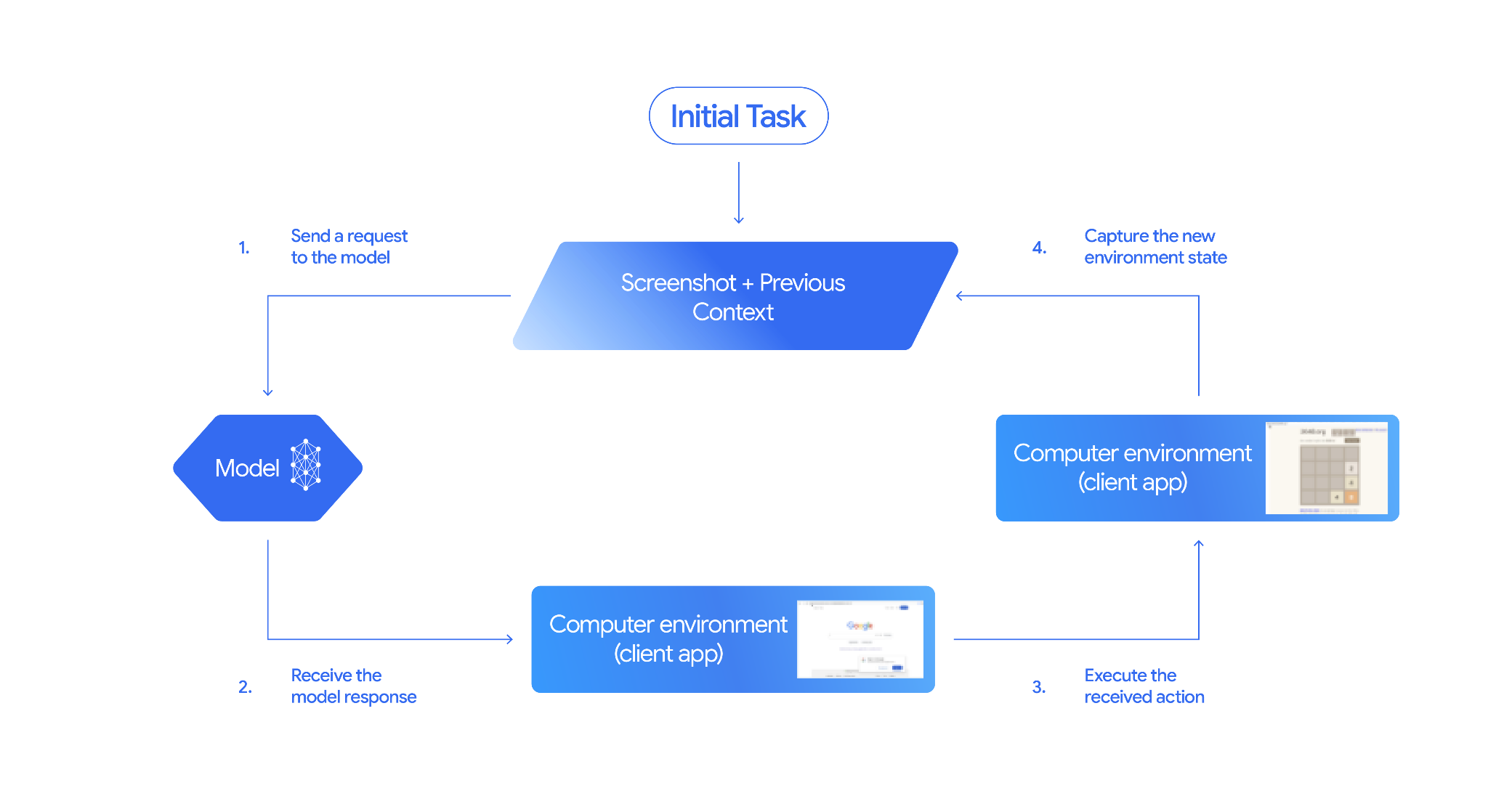
- Google’s October 30 changelog makes Computer Use generally available through both Interactions and GenerateContent. This is a tool-availability milestone, not a new Gemini model launch.
- The model reads screenshots and returns clicks or keystrokes. Developers must supply the execution environment and action handler; this is not a ready-made autonomous desktop or an Android default-assistant change.
- Supported models include Gemini 4 Argon, 3.8 Flash (Google’s recommendation), 3.5 Flash-Lite and 3 Flash Preview. Access is paid-tier only, billed as model tokens rather than completed tasks.
- Prompt-injection screenshot scanning is opt-in. Applications still need to enforce returned confirmation/blocked decisions, isolate execution and limit where the agent can act; general availability is not a reliability or security guarantee.
A new two-bit path for OpenCL inference
- llama.cpp's b12005 prerelease adds initial Q2_0 support to its OpenCL backend, including Adreno-specific kernels and decode/narrow-batch work.
- This is distinct from the IQ2 OpenCL and FP8 paths covered this morning. It broadens low-bit runtime support; the release supplies no independently verified speedup or universal device-compatibility guarantee.
n8n tightens access to execution data
- n8n 2.45.7 requires execution:read permission when workflow-scoped routes retrieve execution data. For shared automation installations, it is a concrete access-control change worth reviewing rather than a new AI feature.
- The stable patch also fixes IMAP trigger expressions after activation and stops treating user data containing an __isError key as an expression error. The release note does not establish an exploited vulnerability or supply a CVE.
Claude adds one API for tracking who spends what
- Anthropic’s beta Usage and Cost Analytics API reports token/request counts and USD cost for Claude Console and Enterprise organizations through two shared endpoints.
- Teams can attribute usage by model, workspace, API key or requesting identity, rank their largest consumers and build daily, hourly or per-minute series—useful for finding which agent or project is driving a bill.
- Console organizations need Admin API credentials. Enterprise organizations need Analytics API access and an owner-created key with read:analytics scope. The beta header is analytics-usage-cost-2026-08-24.
- The earlier Usage and Cost API and Enterprise usage/cost-report endpoints are now legacy but remain supported; this is not an announced shutdown or price cut.
A penny per million tokens for small AI decisions
- Baseten’s joey-1 is a small decision model, not a general-purpose chatbot. Given text or images and structured questions, it returns choice, yes/no or scoring probabilities—useful for routing tickets, triage and rubric scoring without generating paragraphs to parse.
- The API lists $0.01 per million input tokens, with cached input and output priced at $0.00. The published Model API context limit is 16K tokens; zero data retention is on by default. Weights are downloadable under MIT.
- Baseten reports 20ms median latency for an average 2,000-token request, not independently tested here. The model card says it trails the larger elephant-1 across the stated public benchmark.
- A documentation conflict matters: the blog advertises 262K for dedicated deployment, but the downloadable checkpoint explicitly limits input to 16,384 tokens. Do not assume the larger limit applies to those weights.
OpenCode can now use your Claude Code login
- OpenCode 2.2.3 adds a built-in Claude Agent provider: install Claude Code, sign in with claude auth login, then select Claude Agent in /connect. It uses that installation's login and models, rather than announcing a new model or free API access.
- Administrators need to review managed policies. integration.use now covers integration accounts only; MCP, skills and plugins have separate mcp.use, skill.use and plugin.use actions. Old prefixed resource rules migrate automatically, but a bare integration.use rule no longer controls those three surfaces.
- TUI plugins require OpenTUI 0.8 or later. Desktop fixes reduce rendering work in long conversations and repeated session-not-found notifications.
Smaller DeepSeek quants still need serious hardware
- Unsloth v0.1.913-beta adds preview Dynamic v3.1 GGUF quantizations of the existing DeepSeek-V4.1-Flash-1017 model. This is a new compression/runtime option, not a newly released DeepSeek model.
- The smallest listed DeepSeek quant is still 233GB on disk. The guide estimates roughly 128–145GB combined RAM/VRAM for its 1-bit path with Engram tables on SSD; context and runtime can require more. Offloading saves resident memory, not storage.
- Unsloth publishes benchmark comparisons and says v3.1 improves its previous quants. Those are the provider's own tests, not independent confirmation of best-in-class accuracy; lower-bit models can also require longer reasoning.
- The same beta lets compatible LoRA/QLoRA MoE training jobs run together with separate adapters. It adds MLX batching for Claude Code, Codex and OpenCode requests, plus cached-prompt reuse when Claude Code connects directly to local GGUFs.
- For image work, Unsloth reports Qwen-Image-2512 up to twice as fast under a 16GB VRAM cap, and FLUX.2-klein-9B loading on Linux with 12.7GB system RAM plus a supported GPU. These gains are vendor measurements; experimental Neural Engine prefill is opt-in and may slightly alter replies.
Agent teams get retryable gates and standard traces
- Sympozium, an MIT-licensed coordination layer for multi-agent systems on Kubernetes, adds in-place gate retries for its harness mode and emits OpenTelemetry gen_ai semantic conventions on agent spans.
- Operators can resume gated work and inspect agent activity with standard tracing systems. Delegation is gated on configured delegation edges.
- This is infrastructure for teams running Kubernetes, not a consumer chatbot. The project explicitly warns its APIs remain in active development; AgentHarness is experimental.
Phoenix upgrades may now require client API keys
- Phoenix 21 changes the defaults for its AI observability server. When authentication is not explicitly configured, non-loopback binding enables it; local loopback binding does not. The default host is now 127.0.0.1.
- Docker's default non-loopback binding therefore requires authentication. Operators should configure API keys for trace exporters and API clients or risk rejected requests. Helm already enabled authentication, so its default is unchanged.
- The --host command-line option is removed in favor of PHOENIX_HOST. Notebook launches now honor authentication settings instead of always disabling it. Set an unpredictable initial admin password and follow the migration guide before exposing the upgraded server.
One prompt, a whole sound scene
- ElevenLabs says SFX v3 follows prompts containing several sounds more reliably than v2, with improved music/vocals and fewer unwanted artifacts. Those are vendor benchmark and quality claims, not independent listening tests.
- Available in ElevenCreative's Flows, Sound Effects tab, Studio and Music Editor, plus the mobile app and ElevenAPI. It is a sound-effects model, not a new long-form music product.
- The announcement does not state v3-specific pricing, quotas or eligible plans. Its Oct 30 update stamp must not be mistaken for a new Oct 30 launch.
Kimi puts printable models and 3D scenes in chat

- Moonshot promoted 3D Make, a K3.1 Pro workflow for turning descriptions, sketches or images into interactive 3D websites, games and models. The official guide offers online previews, conversational revisions, template remixing and export for printing, video or Live Photos.
- Web access requires a Kimi account; the guide also lists iOS, Android and HarmonyOS. Both generation and edits consume the account's unified quota; no separate fixed price is stated.
- Inspect geometry, proportions and structural safety before printing. Generated assets are not validated engineering designs. This is a workflow announcement, not a new foundation model; earlier coverage already shows 3D Make in use.
HomePod mini 2: retail date arrives, Siri AI does not

- Apple's October 13 announcement sets October 30 store availability for the $149 U.S. HomePod mini 2, in the U.S. and more than 23 other countries and regions. The current product page has a Buy option; local stock was not checked.
- Siri AI is promised through a future software update, initially in English in eight listed markets. Buying the speaker today does not establish that the advertised new assistant is already available.
- The S10-powered speaker adds Sound Glow music-reactive lighting and can serve as a Mac default speaker. Four-speaker surround requires the fourth-generation Apple TV 4K; this is not a new announcement today.
Cresta hands customer-agent deployment tools to developers
- Customer and partner developers can now build, test, deploy and optimize customer-facing agents using Cresta Conductor, CLI and a Python AI Agent SDK from their own repositories and CI/CD pipelines.
- Controlled traffic splits, A/B versions, rollback and separate builder/reviewer permissions support staged deployments. The tools support Agent Skills; Cresta Academy adds customer/partner training and certification.
- This expands self-service access: Conductor itself launched in June. Pricing is not disclosed, and vendor claims of one-week implementations or fivefold time savings are not general guarantees.
Persona adds agents to identity-case review
- Persona AI combines an Assistant for querying identity data, Agents for case review and policy workflows, and Extend for permissioned MCP/CLI connections from other AI tools.
- Case Review Agents assemble evidence against a company's policies and expose their reasoning. Cases meeting the team's criteria can be automatically approved; exceptions go to people. Teams still need to determine which consequential decisions are suitable for automation.
- Persona says all three products are available now; no public price is given. Customer speed and agreement figures are case-study claims, not independently established accuracy for other businesses.
Offboarding now includes an employee’s agents
- BetterCloud's October update tracks AI costs and ownership alongside lifecycle actions: create, update or retire agents, control their tools and revoke access. One offboarding workflow can reassign agents to a manager while revoking the departing employee's accounts and sessions.
- The company says IT agents hand execution to approved deterministic workflows, with audit trails and operation-level roles. Custom agents begin with zero access. Discovery covers API keys, MCP servers and supported AI tools—not a proven inventory of every possible agent.
- The release is available to existing customers and MSPs. Broader discovery of agents embedded in SaaS apps remains planned; pricing is not disclosed.
A poisoned Claude Code extension reached Cursor users
- Cursor says an attacker distributed a malicious Anthropic.claude-code 2.1.313 package through its marketplace on 29 October, 09:27–20:35 UTC. The package was not developed by Anthropic. Cursor estimates at most 5,000 affected users; that count is not independently verified.
- Technical investigations by StepSecurity and Socket corroborate an SSH-backdoor attempt. The installer sent host details, added an attacker SSH key and attempted persistence. Failed privilege escalation did not make every attempted installation harmless.
- Cursor says it rebuilt the marketplace, rotated keys and took the attacker’s host offline. If you installed this exact package through Cursor in that window, use the official indicators and remediation guidance. Uninstalling the extension alone does not remove a host-level backdoor.
- The notice does not establish that every Claude Code installation, another marketplace or any particular reader was affected. This is a missed security story, not an incident that began today.
ChatGPT ad variations switch on by default
- OpenAI’s creative-enhancements setting becomes enabled by default for new and existing campaigns today, unless a previous opt-out applies. Campaign settings override the account default.
- Enhancements can change headlines, descriptions, image sizing, translations and destination URLs using the ad, landing page and context. Individual variations can run without a separate approval or complete preview: review the setting before assuming the submitted creative is the only version shown.
- Advertisers can turn it off in Manage Settings. Performance-improvement claims are not proof of causal lift for a particular campaign, and ads remain separate from ChatGPT’s answers.
Tencent expands WorkBuddy’s enterprise reach
- Tencent is extending WorkBuddy to international enterprise customers, connecting agent workflows with messaging and business systems. TokenHub offers a single API for multiple models with centralized governance and billing.
- BuddyOne, a related cross-application collaboration offering, is China-only. These are deployment and integration announcements, not evidence that every connector or region has identical access.
- General release of Hy4 and Hy4 Flash is still forthcoming in the announcement. No release date, public price or independently verified performance is supplied; do not confuse this with the earlier Hy4 preview.
Coverage is drawn from public, accessible and indexed sources; it is not an exhaustive view of X and does not access a personal feed. Vendor claims, previews and access limits are identified in each story. This archive preserves the delivered edition; later developments may change availability, prices or incident status.